






















Okay

Get in Touch

General
(508) 921-4600
Sales@ueidaq.com
Support@ueidaq.com

UEI Europe Office
Salesemea@ueidaq.com

Click here for local offices and distributors.

Find us on WeChat.

Distributed Instrumentation for Advanced Reactor Development and Experimental Facilities

Supporting thermal-hydraulic test loops, hardware-in-the-loop systems, component qualification rigs, and digital twin validation environments used in advanced reactor programs.

  • Rugged distributed DAQ hardware
  • Deterministic synchronization using PTP and TSN
  • Modular instrumentation architecture for experimental facilities
Instrumentation Architecture for Advanced Reactor Test Facilities
Instrument Architecture for Advanced Reactor Test Facilities
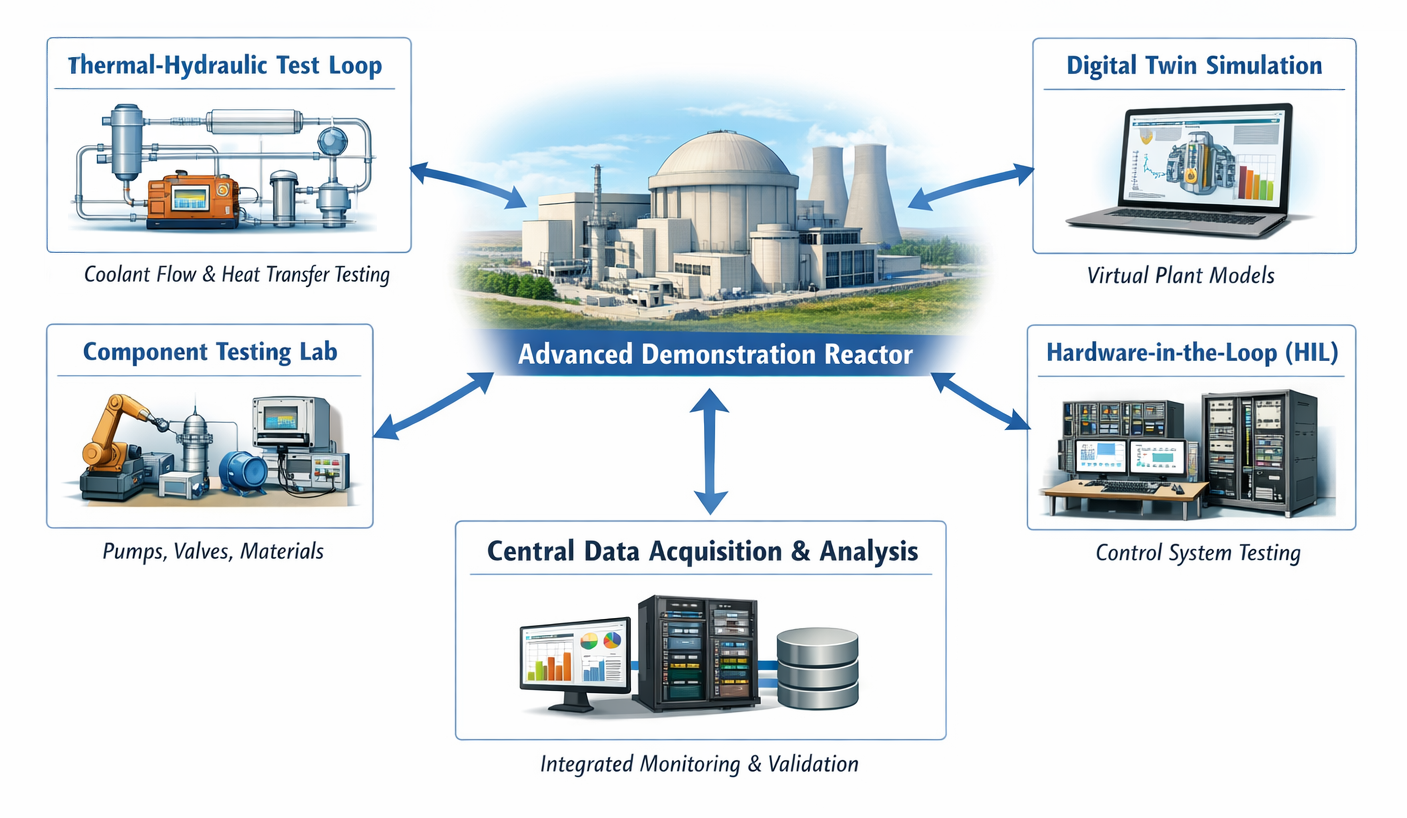
Figure 1—Example instrumentation environment supporting advanced reactor development and experimental test facilities.
Explore Distributed Architectures

Advanced Reactor Instrumentation

Advanced reactor development programs depend on extensive experimental validation. Thermal-hydraulic loops, hardware-in-the-loop environments, component test facilities, and digital twin validation systems require synchronized measurement across large experimental infrastructures.

These experimental facilities support qualification, validation, and verification activities required throughout reactor design, licensing, and demonstration programs.

Why UEI for Reactor Development Programs

Rugged Hardware

Rugged Hardware

Designed for demanding engineering environments including vibration, electrical noise, and temperature variation common in experimental reactor test facilities.

Deterministic Synchronization

Deterministic Synchronization

Support for IEEE-1588 Precision Time Protocol (PTP) and Time Sensitive Networking (TSN) enables synchronized measurement across distributed data acquisition systems.

Modular Instrumentation

Modular Instrumentation

Flexible I/O architectures allow instrumentation of thermal-hydraulic loops, component testing rigs, and hardware-in-the-loop environments.

The Changing Nuclear Energy Landscape

Gen-IV Reactor Type Description
Sodium-Cooled Fast Reactor (SFR) Fast neutron reactor with liquid sodium coolant
Lead-Cooled Fast Reactor (LFR) High-temperature reactor using liquid lead coolant
Gas-Cooled Fast Reactor (GFR) Helium-cooled fast neutron reactor
Molten Salt Reactor (MSR) Liquid salt coolant or liquid fuel systems
Supercritical Water Reactor (SCWR) Water-cooled reactor above critical pressure
Very High Temperature Reactor (VHTR) Helium-cooled reactor designed for very high temperatures
Reactor Category Typical Output Description
Large Reactors (Gen III / III+) 900–1600 MWe Traditional utility-scale plants
Small Modular Reactors 50–300 MWe Factory-built modular reactors
Microreactors 1–20 MWe Small reactors for remote or specialized power

REACTOR DEVELOPMENT INFRASTRUCTURE

Instrumentation Challenges in Advanced Reactor Experimental Facilities

Typical Instrumentation in Reactor Development Facilities

These facilities are often operated by reactor developers, national laboratories, and engineering organizations conducting reactor development programs.

Thermocouples • RTDs • Strain gauges • Vibration sensors • Pressure sensors • Flow sensors • Neutron flux detectors • Valve and actuator feedback signals

Large Sensor Networks

Large Sensor Networks

Reactor test loops often require hundreds or thousands of sensors measuring temperature, pressure, vibration, strain, and neutron flux.

Harsh Industrial Conditions

Harsh Industrial Conditions

Instrumentation must tolerate electrical noise, mechanical vibration, and temperature extremes found in experimental facilities.

Synchronized Measurements

Synchronized Measurements

Distributed acquisition systems must maintain deterministic timing across multiple measurement nodes.

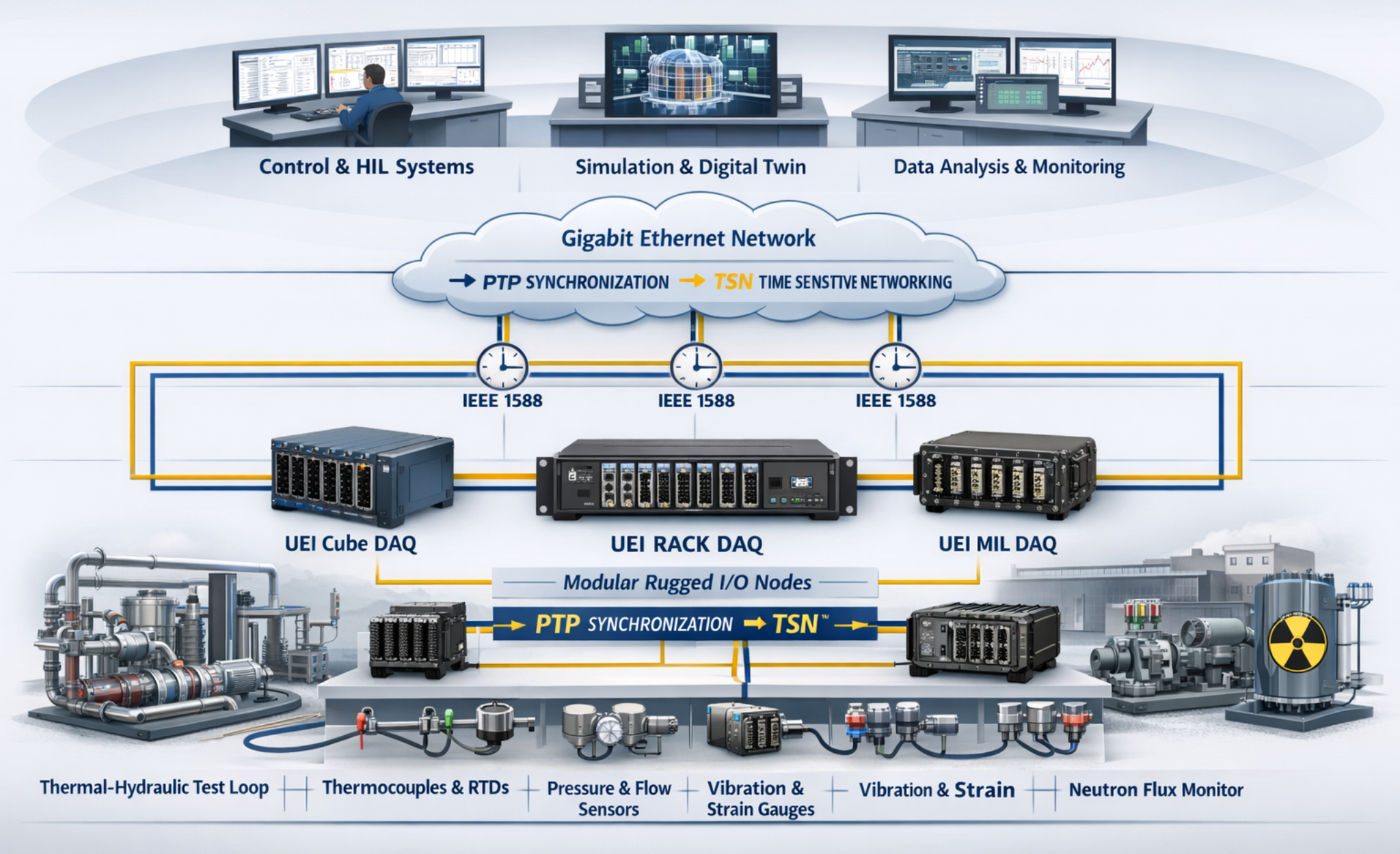
Distributed Data Acquisition Architecture

Distributed DAQ systems place acquisition hardware close to sensors and connect nodes through synchronized networks using PTP and TSN across large experimental reactor facilities.

Instrumentation hardware used in these environments must tolerate electromagnetic interference, mechanical vibration, temperature variation, and electrical noise typical of large experimental test facilities. The architecture shown illustrates how distributed UEI measurement nodes can be synchronized across a TSN/PTP network to support large experimental reactor programs.

  • Shorter sensor wiring improves signal integrity
  • Distributed hardware scales with test facilities
  • PTP enables precise time alignment
  • TSN supports deterministic Ethernet communication
Advanced Reactor Development & Testing Ecosystem
Advanced Reactor Development & Testing System
Figure 2—Example distributed instrumentation architecture illustrating synchronized measurement nodes connected across a TSN/PTP network supporting advanced reactor development test facilities illustrating synchronized measurement nodes connected across a TSN/PTP network supporting large reactor development test facilities. This type of architecture allows instrumentation to scale across large experimental facilities while maintaining deterministic timing between measurement nodes.

NUCLEAR APPLICATIONS

Where UEI Fits in Reactor Development Programs

Advanced reactor development programs require instrumentation across multiple engineering domains. Distributed data acquisition systems support measurements throughout the reactor development lifecycle.

Thermal-Hydraulic Test Loops

Thermal-Hydraulic Test Loops

Instrumentation for large experimental loops measuring temperature, pressure, flow, and vibration. Distributed DAQ nodes reduce wiring complexity while maintaining synchronized measurements across large facilities.

Hardware-in-the-Loop (HIL) Control Systems

Hardware-in-the-Loop (HIL) Control Systems

Reactor control systems are frequently validated using HIL environments integrating plant simulation models, control hardware, and real sensor inputs. Synchronized measurements enable accurate validation of control algorithms and safety systems.

Component and Materials Testing

Component and Materials Testing

Reactor components such as pumps, valves, heat exchangers, and structural materials require high-density instrumentation to measure stress, vibration, and thermal performance during qualification testing.

Digital Twin and Simulation

Digital Twin and Simulation Validation

Advanced reactor programs often integrate simulation models, experimental data, and real-time monitoring. Distributed DAQ platforms provide synchronized measurements supporting model validation and digital twin development.

UEI Data Acquisition Platforms

UEI Chassis

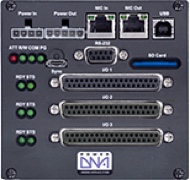
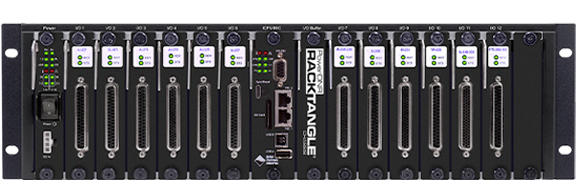
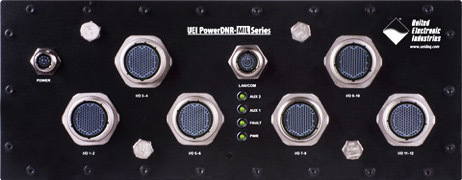
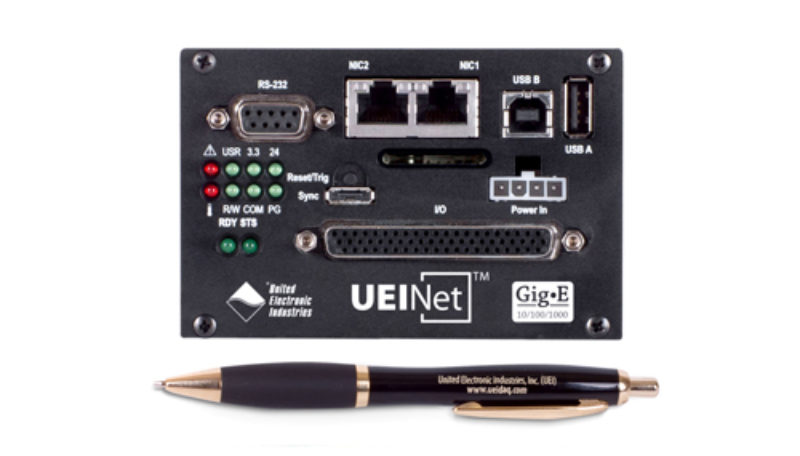
UEI provides rugged modular data acquisition platforms including Cube and RACKtangle systems designed for demanding engineering environments.

These systems support distributed instrumentation, synchronized measurements, and scalable architectures suitable for advanced reactor development facilities and experimental test loops.

UEI systems are designed for rugged industrial environments, making them well suited for instrumentation deployed near pumps, heaters, power electronics, and other demanding experimental infrastructure.

UEI platforms provide the measurement infrastructure required to support modern reactor development programs.

UEI systems are deployed in industrial, aerospace, and energy test environments worldwide.

UEI modular DAQ systems support thousands of synchronized channels across distributed experimental facilities.

NUCLEAR ENGINEERING APPLICATIONS

Example Instrumentation Environments in Advanced Reactor Programs

Advanced reactor development programs rely on a wide range of experimental facilities and test environments where synchronized instrumentation and distributed data acquisition are required.

Thermal Hydraulic Test Loops

Thermal‑Hydraulic Test Loops

Large experimental loops used to evaluate heat transfer, coolant flow behavior, and transient response in reactor systems.

Hardware-in-the-loop (HIL) Control Testing

Hardware‑in‑the‑Loop (HIL) Control Testing

Integration of reactor control hardware with plant simulation models to validate control algorithms and safety system responses.

Component and Materials Qualification

Component & Materials Qualification

Instrumentation used to evaluate pumps, valves, heat exchangers, structural components, and materials under representative operating conditions.

Integrated Effects Testing

Integrated Effects Testing (IET)

Large-scale experimental facilities used to study coupled thermal‑hydraulic and system behavior across multiple reactor subsystems.

Digital Twin Validation

Digital Twin Validation

Measurement systems used to validate simulation models and digital twins against real experimental data.

NUCLEAR DEPLOYMENT EXAMPLE

Framatome MPAT Nuclear Test Platform—Application Brief

UEI hardware is deployed in nuclear maintenance and testing environments through Framatome’s MPAT (Multipurpose Automated Testing) platform, a portable system used to test and maintain instrumentation and control equipment in operating nuclear power plants.

The MPAT system integrates measurement, switching, and control functions into a rugged testing platform designed for demanding industrial environments.

This deployment demonstrates how rugged, modular data acquisition platforms can support real nuclear instrumentation and maintenance environments.

Download the Application Brief

Advanced Reactor Instrumentation White Paper

Read a deeper technical overview of instrumentation architectures supporting advanced reactor development programs.

The white paper covers instrumentation challenges, distributed DAQ architectures, synchronized measurement using PTP and TSN, and rugged platforms for demanding engineering environments.

Download the White Paper

Contact

Todd VanGilder

Todd VanGilder
Business Development Manager—Nuclear Energy
United Electronic Industries

Todd works with advanced reactor developers, national laboratories, and engineering organizations to deploy rugged distributed data acquisition architectures supporting reactor development, validation, and testing programs.

Contact Todd

How to Build Your Perfect System, in 3 Steps

UEI has a chassis style to meet the needs of your application. Whether you need an ultra compact single slot cube or a rugged rack system, UEI has powerful and flexible solutions.

Connections:

And more!

With over 90 I/O boards available, UEI has everything you could possibly need for your data acquisition, control, test and monitoring applications.

Data Acquisition & Control • Test & Simulation • Rugged • Industrial SCADA • Measurement & Logging • Health Monitoring and more! We support all the popular OSs and programming languages.

Programming Language

And more!

Operating Systems

And more!

Applications

And more